
The demise of the fossil fuel industry just got real for Australia’s big banks. Having provided the debt that fueled the last big fossil fuel boom, the likes of ANZ, CommBank, NAB and Westpac now find themselves exposed to projects that are both environmentally and financially toxic, as markets for fossil fuels tumble and the world looks to implement the Paris climate change agreement.
Ten #fossilfuel deals hurting the #environment, #climate and the #banks. https://t.co/SV1677CKR8 #banking #climatechange #globalwarming
— Market Forces (@market_forces) May 17, 2016

In May 2016, Westpac revealed lower than expected cash profits of $3.9 billion, having added $252 million to it’s bad debt charge for the quarter. According to CEO Brian Hartzer, these “higher impairment charges related principally to four large exposures,” and commentators have pointed to Peabody Energy and Wiggins Island Coal Export Terminal (WICET) as likely offenders.
Just a few days later ANZ announced a 24% drop in profits in the six months to March, with its cash profit coming in at $2.8 billion – some $800 million less than expected. The bank is now provisioning a massive $918 million for bad debts, citing “weakness associated with low commodity prices in the resources sector and in related industries.” According to Fairfax, ANZ is facing particular problems from its big business lending, pointing to Peabody as a “major ANZ client culprit.”
Bad debt charges cost NAB $341m for the quarter, although this was slightly less than the same time last year, when they were forced to add an overlay for bad mining and agriculture debts.
Also in May, CommBank announced it’s bad debts had increased to $6.3 billion, the highest reported since December 2014. Loan impairments cost the bank $427m during the third quarter of the 2015-16 financial year, including “a single relatively large domestic exposure with a syndicate of lenders including other Australian major banks.” Wondering what that deal could be? Take a look at the list of projects below – see if you can spot it!
At the same time, the collective public ambition to transition to a low carbon economy has never been stronger, as we begin to see some of the terrifying effects of climate change that will only worsen as the world continues warming to unprecedented levels. Politicians are slowly catching up with the rest of the world, highlighted by the Paris agreement to keep global warming well below 2°C. The carbon budget imposed by this limit means around 80% of global fossil fuel reserves must remain in the ground.
Below are ten of the worst coal and gas deals currently hanging over the Australia’s banks, threatening to leave them billions of dollars out of pocket.
#1 Wiggins Island Coal Export Terminal
Plans for the Wiggins Island Coal Export Terminal (WICET) were originally cooked up by Glencore and its seven project partners in 2008, when the project was approved as an 84 million tonne per year export facility. Only one of the three stages of the project has ultimately gone ahead – albeit at twice the cost. Since then, thermal coal markets have dried up, prices have dropped 75% and two of the project’s proponents – Bandanna Energy and Cockatoo Coal – have gone into administration.
Export charges at WICET are up to five times more expensive than other ports and the six remaining partners have to pay for Bandanna and Cockatoo’s unused capacity, a total extra cost of $150m per annum. So while the port is operating well below capacity, these tough contract terms are keeping it afloat for now. But if the mounting pressures become too much for any of the remaining counterparties to bear, the entire project could go under.
In June 2015, Lloyds Bank scrambled to offload its $100 million exposure to WICET. Reuters has since reported that other lenders, owed more than $3b in total, may also be looking to on-sell their loans at less than face value. So which Aussie banks are amongst these nervous debtors?
ANZ is the most heavily exposed, having provided $417m worth of project finance in 2011. That deal also saw CommBank, Westpac and NAB each chip in $164m, meaning that all of our big banks are tied to the misfortunes of the dodgy coal port. The loan is due to be fully repaid by late 2018, but this is looking less and less likely as the structural decline of the coal industry continues to drag producers down.
Bad loans with Wiggins Island #Coal Export Terminal & Peabody drag down @Westpac profits #divest via @BIAUS https://t.co/Y0HQV5XsEz
— Market Forces (@market_forces) May 2, 2016

#2 Peabody Energy
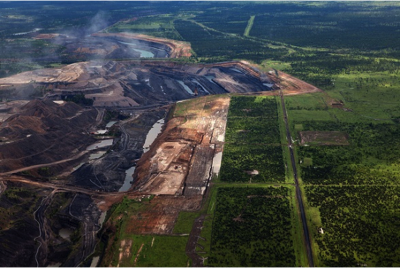
Coal mining in Queensland’s Bowen Basin, where Peabody operates six mines.
Credit: Greenpeace/Tom Jefferson
On 13 April, Peabody Energy filed for Chapter 11 bankruptcy protection under US law, unable to service its $8b of debt. Peabody was the world’s biggest privately-owned coal producer, but these days that’s not a great claim to fame, with the industry experiencing rapid structural decline.
Throughout 2015, Peabody suffered an annual loss of over $2.5b and saw its share price plummet some 97%. Before its bankruptcy announcement, the company’s corporate debt was trading in some instances of less than 1% of what it was issued at.
Three of Australia’s big banks may be caught up Peabody’s demise, with CommBank, NAB and Westpac each having contributed to $49m to facilitate Peabody’s purchase of Macarthur coal in October 2011. Since then, the debt has been downgraded by both major ratings agencies – Moody’s and Standard & Poor’s – to ‘very high’ and ‘substantial’ risk ratings respectively. Although Peabody’s Australian operations are supposedly continuing unchanged, their opaque corporate structure means it’s difficult to tell what effect a restructure brought on by Chapter 11 proceedings will have.
Demise of #Peabody contributes to @ANZ_AU $918m provision for bad debts – 1H profit slumps 22% #divest https://t.co/40iprECo00 via @@abcnews
— Market Forces (@market_forces) May 3, 2016
#3 Adani Abbot Point Coal Port
Adani’s Abbot Point terminal was hit with a credit rating downgrade in March, now sitting just one notch above ‘junk’ status. Despite destructive plans to expand the port to accommodate coal from the Galilee Basin, current forecasts for coal demand would actually see a decrease in the volume going through Abbot Point.
The sorry state of the international coal market highlights the utter absurdity of Adani’s Carmichael/Abbot Point plans. So far, only NAB have been prudent enough to rule out financing any of these ridiculous plans, but the other three big banks remain in the picture as potential lenders.
Two Australian banks are heavily exposed to the existing Abbot Point terminal, with CommBank and Westpac having contributed to a 2013 refinancing deal. CommBank stumped up a massive $707m, while Westpac provided $417m. With such high stakes, the ratings downgrade would have come as a heavy blow to both banks.

Abbot Point coal terminal in the Great Barrier Reef World Heritage Area
Credit: Greenpeace/Tom Jefferson
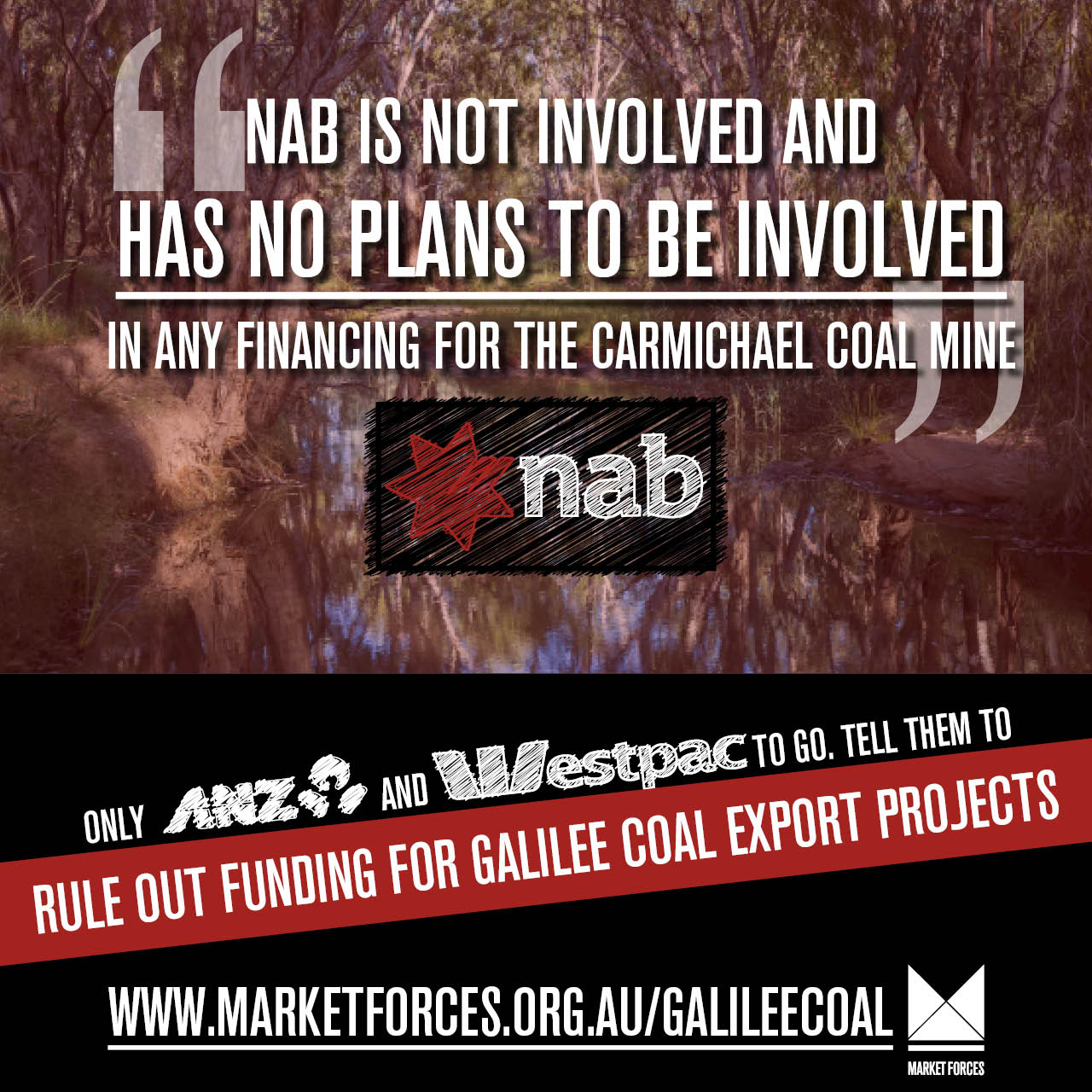
Click the image above to tell ANZ, Westpac and CommBank to rule out financing Adani’s dirty coal plans.
#4 Whitehaven Coal
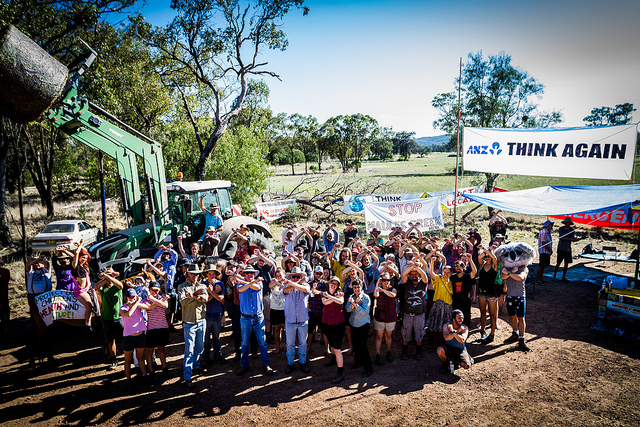
Maules Creek project blockade 2013
Leard State Forest, NSW
As a pure-play coal company, Whitehaven’s fortunes have no insulation against the structural decline of the industry, which has seen the company’s market value drop more than 90% from its April 2011 peak.
Whitehaven owns and operates one underground and four open-cut coal mines, including Maules Creek. Having destroyed part of NSW’s Leard Forest, the Maules Creek project has been the target of strong and sustained community opposition due to its horrific environmental impacts.
Despite Whitehaven’s obvious struggles and lack of social license to carry on its operations, the company attracted a $1.4b refinancing loan announced in March 2015, with ANZ, NAB and WBC each contributing $100m. Just a few months later, it was reported that nervous lenders were already looking to exit the deal, with the huge risks associated with exposure to the coal industry finally beginning to sink in for at least one bank.
#5 Port of Newcastle
The world’s largest coal port is being put under significant pressure by Peabody’s demise – the coal miner is one of the port’s six owners and makes up 14% of the port’s total volume. Deeply troubled Whitehaven Coal is also a ‘shipper shareholder.’ Newcastle is currently under review for downgrade, Moody’s analyst Mary Anne Low stating that “the sustained weakness in coal prices and the uncertain duration of the downturn is increasing the likelihood of counterparty failure and consequent volatility in NCIG’s cash flows”.
Basically, they’re not sure that Newcastle’s owners are going to get paid.
CommBank, ANZ and Westpac all helped finance the hugely expensive project back in 2014, contributing $360m, $294m and $102m respectively.
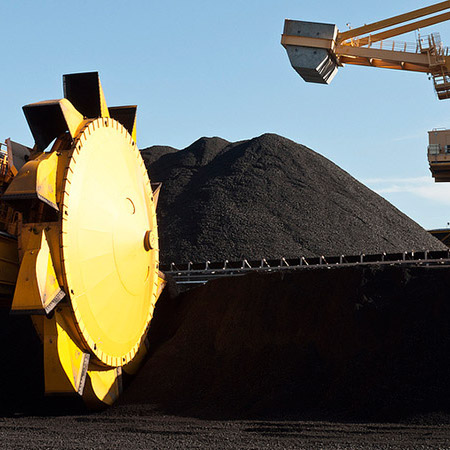
Coal reclaimer at Port of Newcastle
Credit: Max Phillips (Jeremy Buckingham MLC)
#6 Dalrymple Bay Coal Terminal
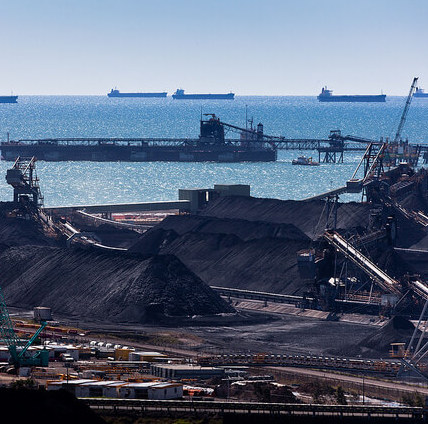
Dalrymple Bay Coal Terminal
Hay Point, Qld
Credit: Greenpeace/Tom Jefferson
Dalrymple Bay is yet another example of an Australian coal port under extreme pressure from the industry’s downturn. Moody’s in March downgraded Dalrymple’s credit rating to non-investment grade. That was before Peabody’s bankruptcy announcement, which would have sent further shivers through Dalrymple – Peabody currently produces a quarter of all coal shipped from the port!
With the future of Peabody’s Australian operations now under a very dark cloud, Dalrymple’s creditors must be getting worried. Those creditors include ANZ and Westpac, who each loaned $50m in September 2014.
#7 Origin – APLNG
Origin’s APLNG project is one of three massive, high-cost LNG facilities recently built on Queensland’s Curtis Island. With a whopping price tag of $24.7b, APLNG was a bullish bet on huge future LNG demand from the likes of Japan, Korea and China. This hasn’t eventuated, with China’s demand remaining steady and Japan and Korea’s actually declining over the past year.
With an extra 100 million tonnes of LNG about to flow from new projects into the global market, prices have been pushed to less than a quarter of what they were in early 2014. The spot price of around US$4.50 per unit is so low that APLNG exports can’t cover its operational and financing costs. That’s right – this $25b mega project is currently running at a loss!
After downgrades in 2015, both major ratings houses – Moody’s and Standard & Poor’s – currently list Origin at just above junk status. Recent reports suggest Origin is looking to separate its oil and gas production arm from its domestic power business in a bid to prevent further downgrades. This will come as a concern for each of Australia’s big banks, who are all heavily exposed to the struggling company.
In September 2011, ANZ and NAB each contributed $250m to a corporate financing deal, while each of the big four participated in the APLNG project financing in May 2012. That deal saw ANZ stump up $359m, Westpac $307m, and NAB and CommBank $256m each. As if these numbers weren’t big enough, NAB, ANZ and CommBank each contributed a further $200m in a December 2014 refinancing.
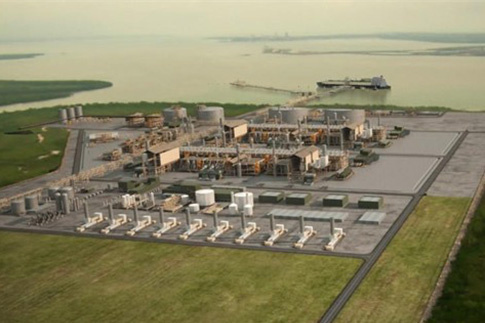
APLNG, GLNG and QCLNG plants at Gladstone in the Great Barrier Reef World Heritage Area
Credit: GreensMPs
#8 Santos – GLNG
Santos’ GLNG project, also residing on Curtis Island in the Great Barrier Reef World Heritage Area was written down to the tune of $565m in 2015 from approximately $10b. This impairment contributed to Santos’ massive total $2.7b loss throughout 2015.
GLNG is supplied by Santos’ highly controversial coal seam gas (CSG) projects in Queensland’s Bowen and Surat Basins. As more is being understood about the serious risks posed by CSG production, community opposition is mounting, leading to a moratorium on the practice in some Australian states.
On top of this, Santos’ proposed Narrabri CSG project has hit a number of stumbling blocks including strong community opposition. The Narrabri project was written down by $800m to $500m in 2015, before Santos announced in February that it had written down the total value of its NSW assets to $0. It now seems unlikely Narrabri will ever produce the gas Santos was expecting, and questions must be raised over the company’s ability to produce the volumes of gas required to fully supply GLNG.
When GLNG was originally financed in 2011, ANZ contributed $305m and NAB and CommBank each chipped in $132m. In December 2014, ANZ also provided a $1b bilateral bank facility to Santos to help restructure the crippling debt obligations imposed by GLNG, Narrabri and other struggling projects.
Santos in real trouble as oil, AUD sinks #divest #noCSG https://t.co/wDHY0W4Lud
— Market Forces (@market_forces) January 18, 2016
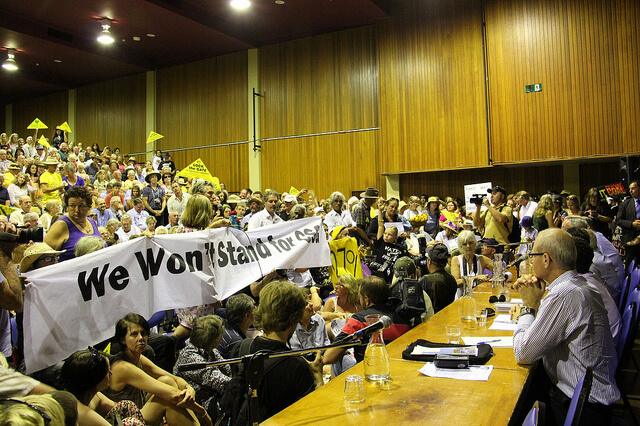
Community opposition to CSG in NSW
Credit: Lock the Gate Alliance
#9 Aurizon
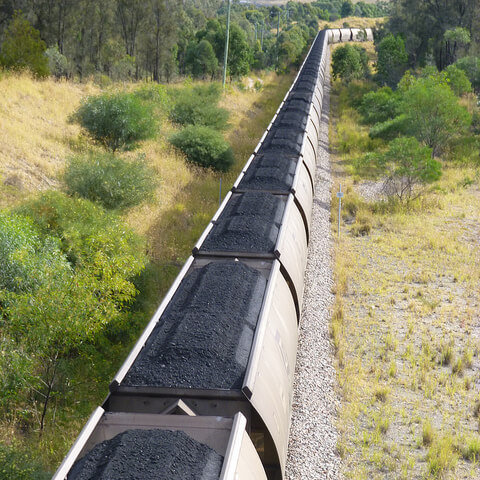
Uncovered coal wagons
Hunter Valley, NSW
Credit: Bob Burton
As the owner and operator of coal and iron ore rail systems, Aurizon is inextricably linked to the fortunes of those industries. In fact, almost 70% of the company’s revenue last year was derived from coal-related business. Recognising that this level of dependence on ailing coal producers is far from a healthy business model, Moody’s in February announced a review of Aurizon’s ‘moderate credit risk’ rating.
With many of Aurizon’s coal-producing clients – including Cockatoo, Peabody and Whitehaven – struggling to hold on through the industry’s structural decline, the flow on effect to Aurizon’s bottom line would have investors very worried.
In mid-2013, each of Australia’s big four banks participated in an Aurizon refinancing deal, which is due to be repaid in 2018. NAB and CommBank each contributed $236m, while ANZ and Westpac loaned $143m apiece.
#10 North East Gas Interconnector
The North East Gas Interconnector proposes to link Tennant Creek in NT to Mt Isa in Queensland, effectively hooking NT gas reserves into the eastern gas market. The contract to construct and operate the pipeline was controversially awarded to Chinese- and Singaporean-owned Jemena, giving the company an unregulated monopoly over the project.
Doubts over just how much gas will actually be supplied from NT reserves have forced the company to reduce the size of the proposed pipe. Growing wariness over unconventional gas extraction and lower than expected demand have led many to question the necessity of the pipeline, but politicians continue to push it as a ‘nation-building’ project.
The $800m project is backed by Chinese and Singaporean state-owned power companies, and has not sought any debt finance from our banks. But this is yet another example of a dodgy fossil fuel project could lock in oversupply and slow down the transition to clean energy sources – all without providing any financial benefit to Australia.
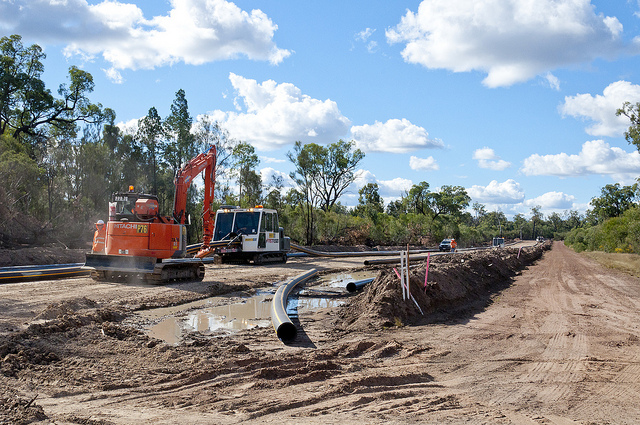
Land clearing for coal seam gas pipeline, Qld
Credit: Max Phillips (Jeremy Buckingham MLC)